editor.divyadaan@sdbinb.in
9764736421
logo

Divyadaan: Journal of Philosophy and Education

📢 Latest Update: New special issue call for papers on "Emerging Technologies in Research" - Submit by March 31, 2026

📢 Latest Update: New special issue call for papers on "Emerging Technologies in Research" - Submit by March 31, 2026

Volume 37, Issue 1 - 2026 (April 2026)

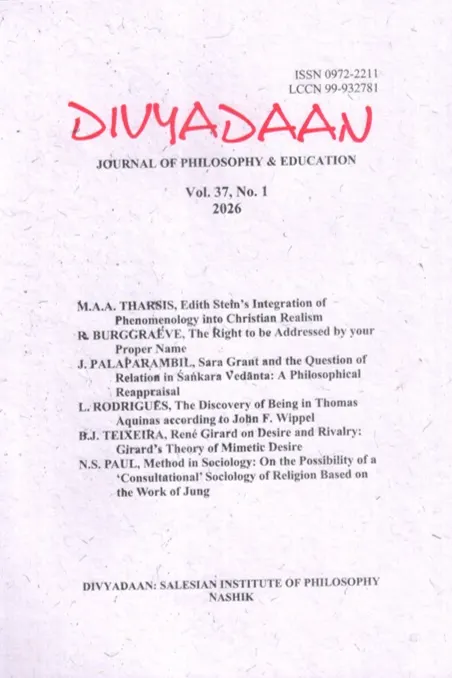
Volume 37 Issue 1 Cover

Issue Details:

Volume 37 Issue 1
Published:Invalid Date

Editorial: April 2026

Welcome to the 2026 issue of Divyadaan: Journal of Philosophy and Education. This issue showcases the remarkable breadth and depth of contemporary research across multiple disciplines. From cutting-edge applications of machine learning in climate science to the revolutionary potential of quantum computing in drug discovery, our featured articles demonstrate the power of interdisciplinary collaboration in addressing global challenges.

We are particularly excited to present research that bridges traditional academic boundaries, reflecting our journal's commitment to fostering innovation through cross-disciplinary dialogue. The integration of artificial intelligence with environmental science, the application of blockchain technology to supply chain management, and the convergence of urban planning with smart city technologies exemplify the transformative potential of collaborative research.

As we continue to navigate an era of rapid technological advancement and global challenges, the research presented in this issue offers both insights and solutions that will shape our future. We thank our authors, reviewers, and editorial board members for their continued dedication to advancing knowledge and promoting scientific excellence.

Banzelao Julio Teixeira and Ivo Coelho
Editor-in-Chief
Divyadaan: Journal of Philosophy and Education

Articles in This Issue

Showing 6 of 6 articles
Research PaperID: DJPE1370002Pages 1-18

EDITH STEIN'S INTEGRATION OF PHENOMENOLOGY INTO CHRISTIAN REALISM

Maria Arul Anthuvan Tharsi

We find a wonderful synthesis of Husserlian phenomenology and Thomism in the later thought of Edith Stein, inspired by her conversion to the Catholic faith. The resulting relational ontology presents being as opening up and unfolding into infinity. Stein9s thought is an integration, not a compromise, of phenomenological attentiveness to lived experience with the metaphysical realism of the Christian tradition, especially of Thomas Aquinas, ordered towards a fuller understanding of the human person as grounded in truth, open to transcendence, and ultimately fulfilled in God.

Edith SteinHusserlian phenomenologyThomismrelational ontologymetaphysical realismtranscendence+4 more
1,501 views
500 downloads

Contributors:

 Maria Arul Anthuvan Tharsi
Research PaperID: DJPE1370003Pages 19-26

THE RIGHT TO BE ADDRESSED BY YOUR PROPER NAME

Roger Burggraeve

Addressing human beings by their proper name expresses the ethical acknowledgment of the other as a unique 'you.' This transcends the 'knowing' of the other-knowing, which, based on perception, is so central to Greek thought. In contrast, in Hebrew thought a shift occurs from seeing to listening and thus it focuses on the direct relationship with the other-face-to-face-as invocation and response. Humans are 'responsible' beings, literally 'answerable-by-and-for-the- other,' according to Emmanuel Levinas. This leads to a reformulation of the Cartesian "cogito, ergo sum" into "respondeo, ergo sum." As 'human condition' this responsibility implies the ethical call to acknowledge and affirm the other as a unique person, always and everywhere. We can also call it a right, even a fundamental right, in the sense that the direct interpersonal relationship ('face-to- face') forms the basis and modality of all humanity, and therefore of all education and counseling, all care, all sociality, economy, and politics. Artificial intelligence and robotization cannot, or rather, should never, replace direct face-to-face interaction, even though they can certainly be useful tools (and remain tools, subject to face-to-face interaction). The use of personal names expresses direct face-to-face interaction in a special, even essential, way, even though proper names can be misused to label, exclude, or persecute others. For privacy and security reasons, it may be necessary to 'anonymize' people, but this should never prevent people from addressing and acknowledging the other as a unique person! Hence the great responsibility when people give their children a (worthy, not crazy) name, precisely so as not to compromise the dignity of the other.

Emmanuel Levinasethical responsibilityface-to-face interactionhuman dignitypersonal identityinterpersonal relationship+9 more
1,739 views
518 downloads

Contributors:

 Roger Burggraeve
Research PaperID: DJPE1370004Pages 27-40

SARA GRANT AND THE QUESTION OF RELATION IN ŚAṄKARA VEDANTA

Jacob Palaparambil

Sara Grant (1922-2000), influenced by Adi Saṅkaracarya and shaped by Richard De Smet, rethinks key metaphysical categories-relation, non-duality, and personhood-without reducing Advaita to Western monism or Christian theism. This article examines her account of relation (saṃbandha) in Saṅkara's thought, situating it within the De Smet School and engaging concepts such as tādātmya, avidyā, adhyāsa, and lakṣaṇā. It argues that Grant develops a philosophically rigorous account of relation as epistemologically necessary and soteriologically significant, though not ultimately real, thereby opening new avenues for comparative philosophy and Hindu-Christian dialogue.

Sara GrantAdi ShankaracharyaRichard De SmetAdvaita Vedantanon-dualityrelation (saṃbandha)+10 more
1,984 views
496 downloads

Contributors:

 Jacob Palaparambil
Research PaperID: DJPE1370005Pages 41-52

THE DISCOVERY OF BEING IN THOMAS AQUINAS ACCORDING TO JOHN F. WIPPEL

Leon Rodrigues

John Wippel, a Thomistic interpreter of the Gilsonian version of Existential Thomism states that the metaphysical thought of Thomas Aquinas has been a singular effort of the discovery of being as real or as existing which in turn makes it easier for us to understand being as being or ens commune. This task is processed through the intellect9s two operations, viz., its first operation, i.e., simple apprehension wherein we come to the knowledge of 8the essential nature of something9 or 8of what things are9 and its second operation called judgement. Further, it is only through a special kind of judgement known as separatio that we come to discover being as being or ens commune or being in general as Thomas Aquinas calls it.

John WippelThomas AquinasExistential Thomismmetaphysics of beingens communebeing as being+7 more
1,939 views
609 downloads

Contributors:

 Leon Rodrigues
Research PaperID: DJPE1370006Pages 53-72

RENE GIRARD ON DESIRE AND RIVALRY Part 1: Girard's Theory of Mimetic Desire

Banzelao Julio Teixeira

This essay traces Girard's intellectual journey and shows how his central insight-that human desire is fundamentally imitative-not only shapes personal identity but also leads to rivalry and conflict. It begins by explaining the triangular structure of desire through the relation between subject, object, and model, and develops Girard's distinctions between external and internal mediation, mimetic rivalry, contagion, and metaphysical desire. It further demonstrates the relevance of mimetic theory to consumer culture, social media and political polarization. Finally, the article offers a critical appraisal, highlighting both the interpretive power of Girard's framework and its limits, especially its tendency toward universalization and reductionism.

René Girardmimetic theoryimitative desiretriangular desiremimetic rivalryexternal mediation+9 more
2,186 views
555 downloads

Contributors:

 Banzelao Julio Teixeira
Research PaperID: DJPE1370007Pages 73-106

METHOD IN SOCIOLOGY On the Possibility of a 'Consultational' Sociology of Religion Based on the Work of Jung

Nirmal Savio Paul

Here, we propose, via Jung, a methodological shift in Sociology of Religion (SoR). We seek an invariant non-reductionist method in SoR regarding the depths of religious experience. We hypothesise that, encouraged by Taylor's characterisation of secularisation, taking the authentic subjectivity (in the Lonerganian sense) of the sociological investigator of religion as starting-point, and the consultational recommendation of Wheeldon as the interaction paradigm, we would have a prototypical methodological toolbox for a non-condescending approach in SoR. The proposed approach evades the trap of overarching narratives, while retaining commitment to scientific rigour, without discarding the existing theoretical heritage of SoR.

Carl JungSociology of Religionnon-reductionismreligious experiencesecularizationCharles Taylor+8 more
2,318 views
695 downloads

Contributors:

 Nirmal Savio Paul
Whatsapp