Archive
Browse all published issues of Divyadaan. Discover groundbreaking research and scholarly contributions across all volumes and years.
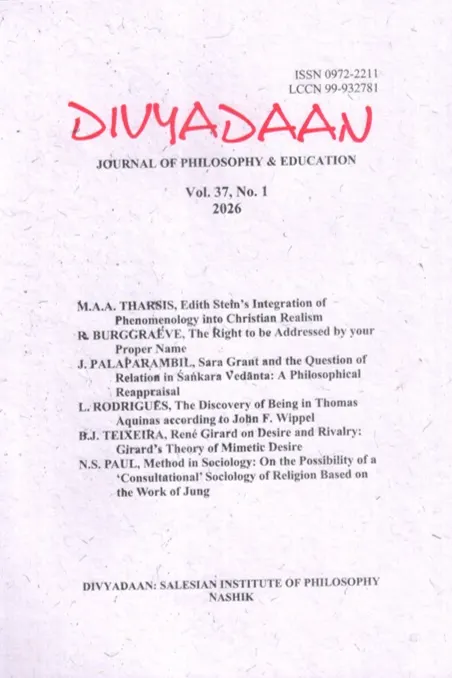
Volume 37, Issue 1 - 2026 (April 2026 )
The present issue of Divyadaan brings together six scholarly articles exploring questions of being, personhood, relation, desire, ethics, and religion from diverse philosophical perspectives. The contributions engage phenomenology, Thomism, Levinasian ethics, Advaita Vedānta, Girardian thought, and the sociology of religion, offering resources for contemporary philosophical reflection, interdisciplinary engagement and interfaith dialogue. Maria Arul Anthuvan Tharsis, in “Edith Stein’s Integration of Phenomenology into Christian Realism,” examines the remarkable synthesis of Husserlian phenomenology and Thomistic metaphysics in the later thought of Edith Stein. The article shows that Stein’s engagement with phenomenology is not a compromise with Thomistic realism but an integration of phenomenological attentiveness to lived experience with metaphysical realism. Her resulting relational ontology understands ‘being’ as opening and unfolding towards infinity, while presenting the human person as grounded in truth, open to transcendence, and ultimately fulfilled in God. Roger Burggraeve, in “The Right to Be Addressed by Your Proper Name,” develops a Levinasian understanding of the ethical recognition of the other. Through the significance of the proper name and the face-to-face encounter, the article emphasizes responsibility for the other and proposes a movement from the Cartesian cogito, ergo sum to respondeo, ergo sum. It considers the implications of this fundamental interpersonal responsibility for education and for the ministry of care, insisting that technological tools should never replace genuine face-to-face human encounter. Jacob Palaparambil, in “Sara Grant and the Question of Relation in Śaṅkara Vedānta: A Philosophical Reappraisal,” offers a philosophical reappraisal of Sara Grant’s engagement with Ādi Śaṅkarācārya which was significantly shaped by Richard De Smet. The article examines how Grant rethinks the metaphysical questions of relation, non-duality, and personhood without reducing Advaita Vedānta either to Western monism or to Christian theism. It argues that relation is epistemologically necessary and soteriologically significant, though not ultimately real within Advaita, thereby opening possibilities for comparative philosophy and interfaith dialogue. Leon Rodrigues, in “The Discovery of Being in Thomas Aquinas according to John F. Wippel,” examines Wippel’s interpretation of Aquinas’s metaphysics as a sustained inquiry into being as real or existing. Particular attention is given to the intellect’s two operations—simple apprehension and judgment—and especially to separatio, through which the intellect moves beyond knowing what things are towards the discovery of being as being or ens commune. The study highlights the distinctive character of Aquinas’s metaphysical project and the significance of the discovery of being for understanding his existential Thomism. Banzelão Julio Teixeira, in “René Girard on Desire and Rivalry: Part 1: Girard’s Theory of Mimetic Desire,” traces Girard’s intellectual development and introduces his foundational insight that human desire is fundamentally imitative. The article explains the triangular structure of desire through the relationship between subject, object, and model, and examines external and internal mediation, mimetic rivalry, contagion, and metaphysical desire. It shows how imitation contributes not only to personal identity but also to rivalry and conflict, and considers the contemporary relevance of mimetic theory to consumer culture, social media, and political polarization. Nirmal Savio Paul, in “Method in Sociology: On the Possibility of a ‘Consultational’ Sociology of Religion Based on the Work of Jung,” proposes a methodological reorientation in the Sociology of Religion that takes religious experience seriously without reducing it to purely sociological, psychological, or cultural explanations. Drawing on Jung, Charles Taylor, Bernard Lonergan, and others, the article explores a non-reductionist approach attentive to the depth of religious experience. It brings together Taylor’s understanding of secularisation, Lonergan’s notion of the authentic subjectivity of the investigator, and Wheeldon’s “consultational” interaction paradigm.
Recent Articles:
Nirmal Savio Paul
Banzelao Julio Teixeira
Lawrance Vincent et al.