
Current Issue
Volume 37, Issue 1 - 2026 (April 2026)
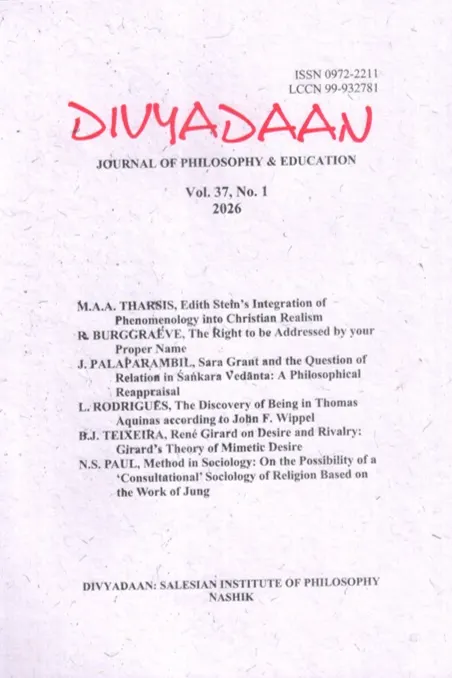
Issue Details:
Volume 37 Issue 1 (April 2026)Issue Description:
The present issue of Divyadaan brings together six scholarly articles exploring questions of being, personhood, relation, desire, ethics, and religion from diverse philosophical perspectives. The contributions engage phenomenology, Thomism, Levinasian ethics, Advaita Vedānta, Girardian thought, and the sociology of religion, offering resources for contemporary philosophical reflection, interdisciplinary engagement and interfaith dialogue. Maria Arul Anthuvan Tharsis, in “Edith Stein’s Integration of Phenomenology into Christian Realism,” examines the remarkable synthesis of Husserlian phenomenology and Thomistic metaphysics in the later thought of Edith Stein. The article shows that Stein’s engagement with phenomenology is not a compromise with Thomistic realism but an integration of phenomenological attentiveness to lived experience with metaphysical realism. Her resulting relational ontology understands ‘being’ as opening and unfolding towards infinity, while presenting the human person as grounded in truth, open to transcendence, and ultimately fulfilled in God. Roger Burggraeve, in “The Right to Be Addressed by Your Proper Name,” develops a Levinasian understanding of the ethical recognition of the other. Through the significance of the proper name and the face-to-face encounter, the article emphasizes responsibility for the other and proposes a movement from the Cartesian cogito, ergo sum to respondeo, ergo sum. It considers the implications of this fundamental interpersonal responsibility for education and for the ministry of care, insisting that technological tools should never replace genuine face-to-face human encounter. Jacob Palaparambil, in “Sara Grant and the Question of Relation in Śaṅkara Vedānta: A Philosophical Reappraisal,” offers a philosophical reappraisal of Sara Grant’s engagement with Ādi Śaṅkarācārya which was significantly shaped by Richard De Smet. The article examines how Grant rethinks the metaphysical questions of relation, non-duality, and personhood without reducing Advaita Vedānta either to Western monism or to Christian theism. It argues that relation is epistemologically necessary and soteriologically significant, though not ultimately real within Advaita, thereby opening possibilities for comparative philosophy and interfaith dialogue. Leon Rodrigues, in “The Discovery of Being in Thomas Aquinas according to John F. Wippel,” examines Wippel’s interpretation of Aquinas’s metaphysics as a sustained inquiry into being as real or existing. Particular attention is given to the intellect’s two operations—simple apprehension and judgment—and especially to separatio, through which the intellect moves beyond knowing what things are towards the discovery of being as being or ens commune. The study highlights the distinctive character of Aquinas’s metaphysical project and the significance of the discovery of being for understanding his existential Thomism. Banzelão Julio Teixeira, in “René Girard on Desire and Rivalry: Part 1: Girard’s Theory of Mimetic Desire,” traces Girard’s intellectual development and introduces his foundational insight that human desire is fundamentally imitative. The article explains the triangular structure of desire through the relationship between subject, object, and model, and examines external and internal mediation, mimetic rivalry, contagion, and metaphysical desire. It shows how imitation contributes not only to personal identity but also to rivalry and conflict, and considers the contemporary relevance of mimetic theory to consumer culture, social media, and political polarization. Nirmal Savio Paul, in “Method in Sociology: On the Possibility of a ‘Consultational’ Sociology of Religion Based on the Work of Jung,” proposes a methodological reorientation in the Sociology of Religion that takes religious experience seriously without reducing it to purely sociological, psychological, or cultural explanations. Drawing on Jung, Charles Taylor, Bernard Lonergan, and others, the article explores a non-reductionist approach attentive to the depth of religious experience. It brings together Taylor’s understanding of secularisation, Lonergan’s notion of the authentic subjectivity of the investigator, and Wheeldon’s “consultational” interaction paradigm.
Banzelao Julio Teixeira
Editor-in-Chief
Divyadaan
Articles in This Issue
 Open Access
EDITH STEIN'S INTEGRATION OF PHENOMENOLOGY INTO CHRISTIAN REALISM
We find a wonderful synthesis of Husserlian phenomenology and Thomism in the later thought of Edith Stein, inspired by her conversion to the Catholic faith. The resulting relational ontology presents being as opening up and unfolding into infinity. Stein's thought is an integration, not a compromise, of phenomenological attentiveness to lived experience with the metaphysical realism of the Christian tradition, especially of Thomas Aquinas, ordered towards a fuller understanding of the human person as grounded in truth, open to transcendence, and ultimately fulfilled in God.
Contributors:
Open AccessTHE RIGHT TO BE ADDRESSED BY YOUR PROPER NAME
Addressing human beings by their proper name expresses the ethical acknowledgment of the other as a unique 'you.' This transcends the 'knowing' of the other-knowing, which, based on perception, is so central to Greek thought. In contrast, in Hebrew thought a shift occurs from seeing to listening and thus it focuses on the direct relationship with the other-face-to-face-as invocation and response. Humans are 'responsible' beings, literally 'answerable-by-and-for-the- other,' according to Emmanuel Levinas. This leads to a reformulation of the Cartesian "cogito, ergo sum" into "respondeo, ergo sum." As 'human condition' this responsibility implies the ethical call to acknowledge and affirm the other as a unique person, always and everywhere. We can also call it a right, even a fundamental right, in the sense that the direct interpersonal relationship ('face-to- face') forms the basis and modality of all humanity, and therefore of all education and counseling, all care, all sociality, economy, and politics. Artificial intelligence and robotization cannot, or rather, should never, replace direct face-to-face interaction, even though they can certainly be useful tools (and remain tools, subject to face-to-face interaction). The use of personal names expresses direct face-to-face interaction in a special, even essential, way, even though proper names can be misused to label, exclude, or persecute others. For privacy and security reasons, it may be necessary to 'anonymize' people, but this should never prevent people from addressing and acknowledging the other as a unique person! Hence the great responsibility when people give their children a (worthy, not crazy) name, precisely so as not to compromise the dignity of the other.
Contributors:
Open AccessSARA GRANT AND THE QUESTION OF RELATION IN ŚAṄKARA VEDANTA
Sara Grant (1922-2000), influenced by Adi Saṅkaracarya and shaped by Richard De Smet, rethinks key metaphysical categories-relation, non-duality, and personhood-without reducing Advaita to Western monism or Christian theism. This article examines her account of relation (saṃbandha) in Saṅkara's thought, situating it within the De Smet School and engaging concepts such as tādātmya, avidyā, adhyāsa, and lakṣaṇā. It argues that Grant develops a philosophically rigorous account of relation as epistemologically necessary and soteriologically significant, though not ultimately real, thereby opening new avenues for comparative philosophy and Hindu-Christian dialogue.
Contributors:
Open AccessTHE DISCOVERY OF BEING IN THOMAS AQUINAS ACCORDING TO JOHN F. WIPPEL
John Wippel, a Thomistic interpreter of the Gilsonian version of Existential Thomism states that the metaphysical thought of Thomas Aquinas has been a singular effort of the discovery of being as real or as existing which in turn makes it easier for us to understand being as being or ens commune. This task is processed through the intellect9s two operations, viz., its first operation, i.e., simple apprehension wherein we come to the knowledge of the essential nature of something or of what things are and its second operation called judgement. Further, it is only through a special kind of judgement known as separatio that we come to discover being as being or ens commune or being in general as Thomas Aquinas calls it.
Contributors:
Open AccessRENE GIRARD ON DESIRE AND RIVALRY Part 1: Girard's Theory of Mimetic Desire
This essay traces Girard's intellectual journey and shows how his central insight-that human desire is fundamentally imitative-not only shapes personal identity but also leads to rivalry and conflict. It begins by explaining the triangular structure of desire through the relation between subject, object, and model, and develops Girard's distinctions between external and internal mediation, mimetic rivalry, contagion, and metaphysical desire. It further demonstrates the relevance of mimetic theory to consumer culture, social media and political polarization. Finally, the article offers a critical appraisal, highlighting both the interpretive power of Girard's framework and its limits, especially its tendency toward universalization and reductionism.
Contributors:
Open AccessMETHOD IN SOCIOLOGY On the Possibility of a 'Consultational' Sociology of Religion Based on the Work of Jung
Here, we propose, via Jung, a methodological shift in Sociology of Religion (SoR). We seek an invariant non-reductionist method in SoR regarding the depths of religious experience. We hypothesise that, encouraged by Taylor's characterisation of secularisation, taking the authentic subjectivity (in the Lonerganian sense) of the sociological investigator of religion as starting-point, and the consultational recommendation of Wheeldon as the interaction paradigm, we would have a prototypical methodological toolbox for a non-condescending approach in SoR. The proposed approach evades the trap of overarching narratives, while retaining commitment to scientific rigour, without discarding the existing theoretical heritage of SoR.
Contributors:
Open AccessBOOK REVIEWS
This collection of book reviews critically examines contemporary works in philosophy, religion, spirituality, media studies, and consciousness studies. The reviewed texts engage diverse themes such as the concept of personhood in Advaita Vedanta through Richard De Smet’s interpretation of Sankara, John Henry Newman’s epistemology as a response to modern atheism, Ran Lahav’s contemplative approach in Deep Philosophy, feminist and spiritual reinterpretations of the Ramayana through Sita’s perspective, the social and political dangers of fake news, and neuroscientific explorations of consciousness by Anil Seth. Together, these reviews highlight ongoing dialogues between Eastern and Western philosophical traditions, faith and reason, spirituality and modernity, as well as technology, media, and human identity. The essays emphasize interdisciplinary reflection and demonstrate how philosophical and religious inquiry continue to address contemporary existential, ethical, and cultural concerns.